Beyond the Algorithm: The Human Impact of AI on Cancer Diagnosis and Care
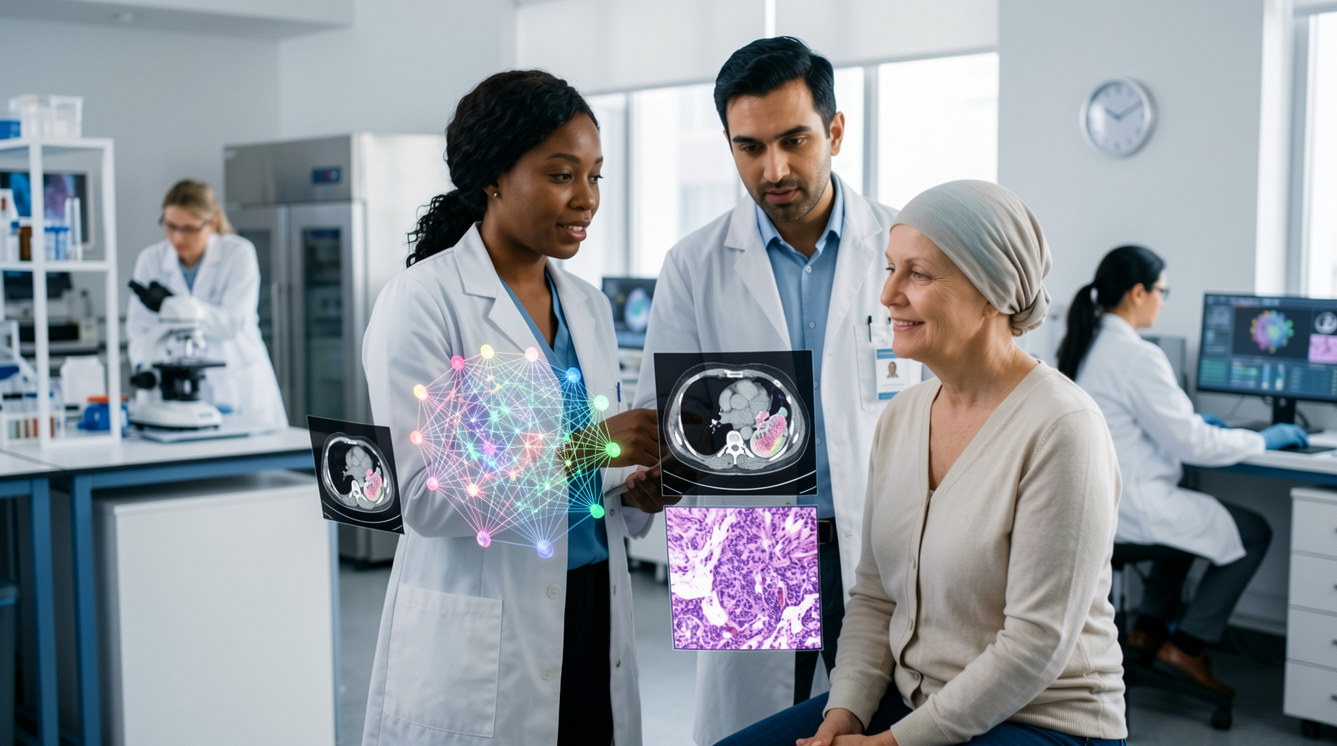
Cancer is a word that carries an undeniable weight. It is one of the most complex, formidable, and deeply personal health challenges humanity faces. While we do not yet have a universal cure, the landscape of oncology is shifting beneath our feet. A powerful new ally has entered the fight, one that is transforming how we understand, track, and attack the disease: Artificial Intelligence.
When we hear "AI in healthcare," it is easy to imagine cold, robotic systems replacing the compassionate doctors we rely on. The reality is profoundly different. AI is not stepping in to replace the human oncologist; it is stepping up as a tireless co-pilot. Think of it as a highly advanced microscope combined with a research assistant that can read a million medical journals in a second.
By revolutionizing the three critical pillars of cancer care: diagnosis, prognosis, and treatment, AI is bringing us closer to a future where medicine is not just highly advanced, but deeply personalized.
1. Diagnosis: Finding It Earlier, Seeing It Clearer
In the fight against cancer, time is our most precious resource. Early detection is often the single biggest factor in saving a life. AI excels at the very core of diagnostic medicine: finding subtle patterns.
A Second Set of Expert Eyes in Radiology
Every day, radiologists review hundreds of complex scans: CTs, MRIs, and mammograms. It is painstaking work, and human eyes naturally experience fatigue. AI algorithms, however, do not get tired. Trained on millions of labeled medical images, these systems can scan a patient's results in seconds. They are increasingly adept at flagging microscopic abnormalities like a faint shadow on a lung scan or a tiny density in breast tissue that might be invisible to the human eye. In fields like mammography, AI is already working alongside doctors to reduce the rates of missed cancers (false negatives).
Accelerating Digital Pathology
Diagnosing cancer often requires a pathologist to examine tissue samples on a glass slide under a microscope. AI is transforming this by analyzing digitized versions of these slides. The technology can rapidly count abnormal cells, identify subtle changes in tissue structure, and even suggest the specific grade or type of cancer. This not only speeds up the diagnostic process but helps eliminate the agonizing waiting periods patients endure for biopsy results
2. Prognosis: Mapping the Journey Ahead
Once a diagnosis is made, the immediate question is: What happens next? Prognosis is not about guessing; it is about making highly informed predictions regarding the likely course of the disease and how a patient will respond to care.
Making Sense of the Data Mountain
A patient’s prognosis is influenced by a staggering amount of data, including their genetics, lifestyle, tumor mutations, and complex medical history. Weighing all these variables perfectly is beyond human capability. AI, however, thrives on complex datasets. It can synthesize a patient's electronic health records, imaging data, and genomic sequences to create a highly accurate, individualized risk profile.
Predicting Treatment Response
Before subjecting a patient to the heavy toll of chemotherapy or radiation, doctors want to know if it will actually work. By analyzing historical data from thousands of patients with similar molecular profiles, AI can help predict how a new patient might respond to a specific drug. This drastically reduces the reliance on "trial-and-error" medicine, sparing patients from the side effects of ineffective treatments and saving valuable time.
3. Treatment: The Era of Precision Oncology
For decades, much of cancer treatment relied on a "one-size-fits-all" approach. But we now know that every person's cancer is as unique as their fingerprint. AI is the engine driving the shift toward precision medicine - therapies tailored to the specific genetic makeup of the patient and their tumor.
Targeted Therapies and Immunotherapy
AI is instrumental in identifying "biomarkers" which are specific genetic signatures within a tumor that reveal its vulnerabilities. By reading a tumor's DNA, AI helps oncologists match patients with targeted drugs designed to attack only the cancerous cells while sparing healthy tissue. Furthermore, it is helping predict which patients are most likely to benefit from immunotherapy, a revolutionary treatment that weaponizes the patient's own immune system against the disease
Supercharging Drug Discovery
Developing a new cancer drug traditionally takes over a decade and costs billions of dollars. AI is fundamentally disrupting this timeline. By simulating how different chemical compounds interact with cancer proteins in a virtual environment, AI can screen millions of potential new drugs in a matter of days. It identifies the most promising candidates for laboratory testing, effectively shaving years off the drug discovery process.
The Synergy of Human and Machine
Despite its immense power, AI does not make the final call. It provides deep, data-driven insights, but the ultimate decisions about care remain firmly in human hands.
The integration of Artificial Intelligence in oncology gives us a profound new advantage. Catching cancer earlier, mapping its trajectory more accurately, and treating it with pinpoint precision turns the tide in favour of the patient. Ultimately, the true promise of AI in medicine is not just technological but deeply human. By handling the overwhelming burden of data, AI frees up doctors to do what machines never will: hold a patient's hand, navigate complex emotional decisions, and deliver compassionate care.